


If your business in the UAE still relies on sending PDF invoices via email or physically printing bills, you are fast approaching a critical operational bottleneck. The UAE government, led by the Ministry of Finance (MoF) and the Federal Tax Authority (FTA), is fundamentally changing the way Business-to-Business (B2B) and Business-to-Government (B2G) transactions are conducted.
Starting in July 2026, the era of the traditional invoice will begin to close. The introduction of the mandatory UAE E-Invoicing system means a PDF is no longer a valid tax document.
This is not a simple software update; it is a complete digital transformation of the UAE’s financial ecosystem. Businesses must act now to understand the new Decentralised Continuous Transaction Control and Exchange (DCTCE) framework, the strict timeline, and why upgrading your ERP system—specifically with an FTA-approved solution like TallyPrime—is non-negotiable.
What is the UAE E-Invoicing Mandate?
Electronic invoicing (e-invoicing) in the UAE means issuing, receiving, and storing invoices in a strictly structured, machine-readable format. Specifically, the UAE has mandated the PINT AE (Peppol International UAE) XML format.
The government has explicitly stated that paper invoices, scanned documents, Word files, and traditional PDF invoices will become obsolete and non-compliant. The new system requires that an invoice be generated as structured data that can be instantly validated, read by other systems, and simultaneously reported to the FTA.
The 5-Corner Model (DCTCE) Explained
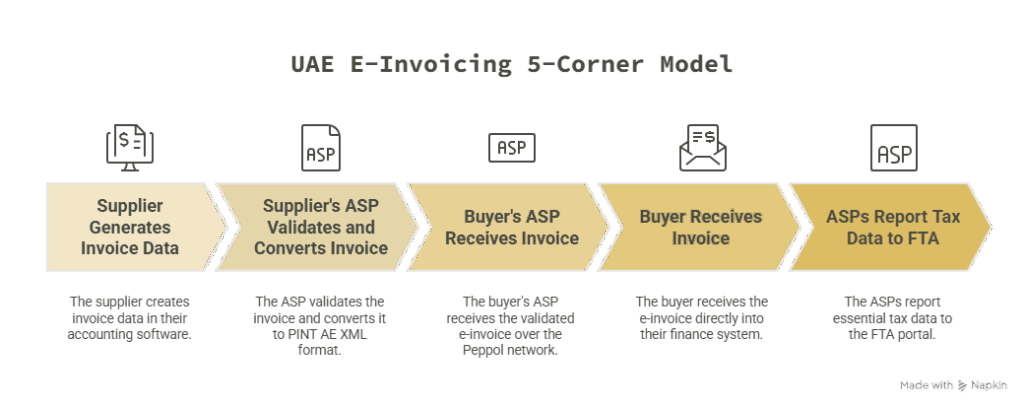
The UAE is implementing the globally recognized Peppol 5-Corner Model, customized for the region as the DCTCE model. This decentralized framework ensures seamless, secure, and real-time data exchange. Here is how your B2B transactions will flow:
- Corner 1 (Supplier): You generate the invoice data in your accounting software (e.g., TallyPrime).
- Corner 2 (Supplier’s ASP): Your system automatically sends this data to your Accredited Service Provider (ASP). The ASP validates the invoice against UAE tax rules, converts it to the mandatory PINT AE XML format, and digitally signs it.
- Corner 3 (Buyer’s ASP): The validated e-invoice is securely transmitted over the Peppol network to your client’s ASP.
- Corner 4 (Buyer): Your client receives the structured e-invoice directly into their finance system for fast, automated processing.
- Corner 5 (The FTA): Simultaneously, the ASPs report the essential tax data (Tax Data Document) directly to the FTA portal.
This automated process guarantees real-time validation, drastically reducing human error, fraud, and VAT discrepancies.
The UAE E-Invoicing Implementation Timeline (2026-2027)
The rollout of the Electronic Invoicing System is phased to allow businesses adequate preparation time. Missing these deadlines will result in severe financial penalties.
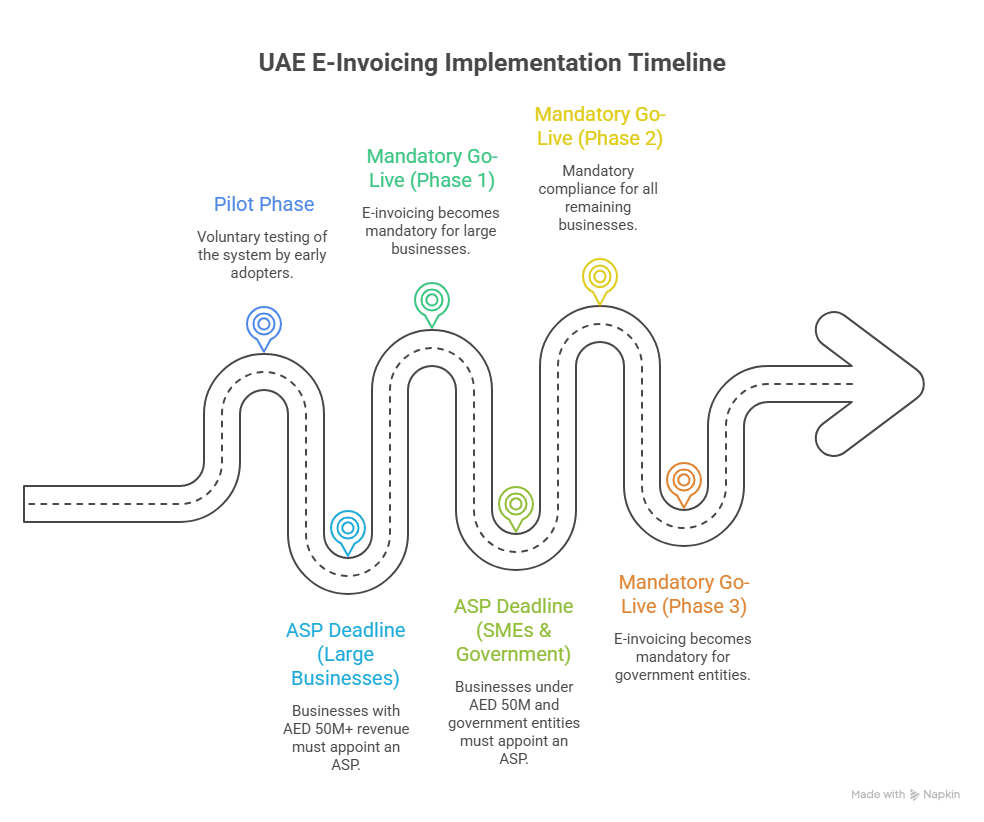
- July 1, 2026 – The Pilot Phase: A voluntary pilot program begins. This is the crucial testing ground for early adopters to refine their systems with the MoF and FTA.
- October 30, 2026 – ASP Deadline for Large Businesses: Businesses with an annual revenue of AED 50 million or more must officially appoint an Accredited Service Provider (ASP).
- January 1, 2027 – Mandatory Go-Live (Phase 1): E-invoicing becomes legally mandatory for all large businesses (AED 50M+ revenue).
- March 31, 2027 – ASP Deadline for SMEs & Government Entities: Businesses with revenue under AED 50M, as well as Government Entities, must appoint their ASP.
- July 1, 2027 – Mandatory Go-Live (Phase 2): Mandatory compliance is enforced for all remaining businesses (revenue less than AED 50M).
- October 1, 2027 – Mandatory Go-Live (Phase 3): E-invoicing becomes mandatory for all Government Entities (B2G transactions).
The Cost of Non-Compliance
The FTA is strict regarding enforcement. Failing to appoint an ASP or implement the e-invoicing system on time will trigger an immediate penalty of AED 5,000 per month of delay. Furthermore, failing to issue or transmit an e-invoice (or electronic credit note) within the required timeframe incurs a fine of AED 100 per document, capped at AED 5,000 monthly.
How E-Invoicing Will Transform Your B2B Operations
While the mandate is a compliance requirement, it offers immense strategic advantages for forward-thinking businesses in Dubai, Abu Dhabi, and across the Emirates.
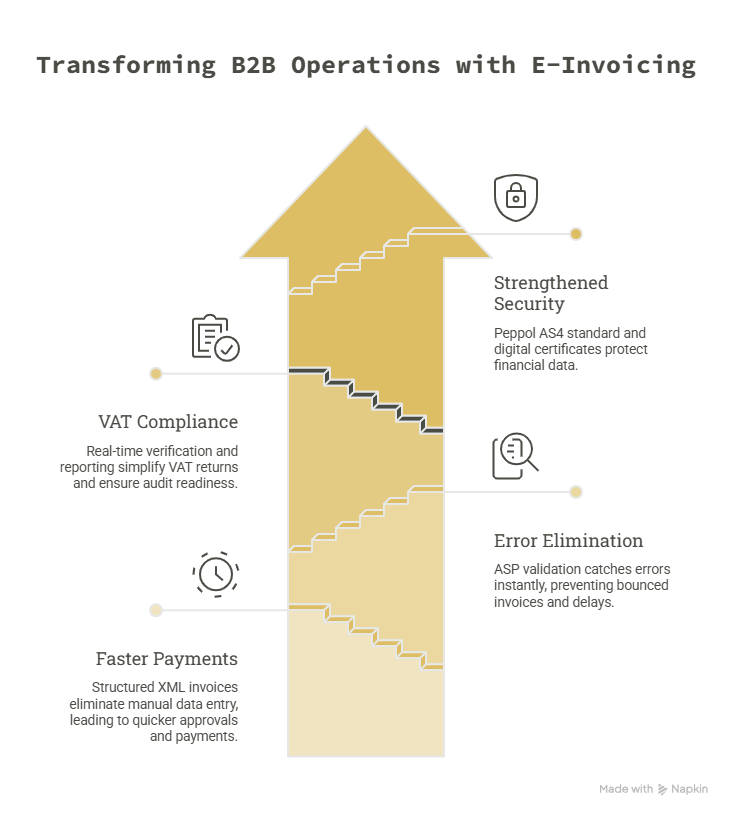
- Faster Payments and Improved Cash Flow: Structured XML invoices eliminate manual data entry for your buyers. With zero manual re-entry and instant validation, invoices are approved and paid significantly faster.
- Elimination of Errors and Disputes: Because the ASP validates the data before it reaches the buyer, missing TRNs, incorrect VAT calculations, or formatting errors are caught instantly. This prevents the traditional “bounced invoice” scenario that delays payments by weeks.
- Effortless VAT Compliance & Audit Readiness: With every transaction verified and reported in real-time, your VAT returns become seamless. TallyPrime ensures all data is archived securely, keeping you permanently audit-ready.
- Strengthened Security: The Peppol AS4 standard ensures bank-level encryption and multifactor authentication. Digital certificates and signatures guarantee the integrity of your financial data.
Why TallyPrime is the Ultimate Solution for UAE E-Invoicing
Transitioning to this new era requires more than just hiring an ASP; it requires an ERP system built for native integration and absolute accuracy. TallyPrime is engineered to be your complete e-invoicing powerhouse.
Here is why TallyPrime is the trusted choice for thousands of UAE businesses:
1. Native PINT AE XML Generation
TallyPrime eliminates the need for manual formatting or third-party converters. The software automatically generates your B2B invoices in the mandated PINT AE XML format, ensuring every one of the 50+ required data fields is perfectly populated according to FTA data dictionaries.
2. Smart In-Built Validations
One of the most common mistakes in e-invoicing is missing or invalid TRNs or incorrect tax base calculations. TallyPrime features smart, in-built validation checks. It detects inconsistencies, missing information, and tax calculation errors before the invoice is sent to the ASP, drastically reducing technical rejections.
3. One-Click 5-Corner Exchange
TallyPrime is designed for the decentralized Peppol framework. With a single click, you can generate and transmit single or batch invoices instantly across the 5-corner model. The seamless API integration with Accredited Service Providers means you never have to leave the Tally interface to ensure compliance.
4. Flawless Electronic Credit Notes
The new rules dictate that once an invoice is transmitted, it cannot be canceled or edited. You must issue an electronic credit note within 14 days. TallyPrime handles structured credit note workflows effortlessly, routing them correctly through your ASP to safeguard your tax accuracy.
5. Centralized Compliance Tracking
Monitor the entire lifecycle of your documents from a single, intuitive report within TallyPrime. You get real-time status updates—knowing exactly when an invoice was validated, delivered, or if it requires attention.
Your 2026 Readiness Action Plan
The July 2026 pilot phase is approaching rapidly. Do not wait until the mandatory deadline to upgrade your systems. Follow this checklist to ensure your business is prepared:
- Assess Your Current Software: Can your current billing system generate UBL 2.1 / PINT AE XML files? If you are relying on basic accounting tools or Excel, it is time to upgrade to TallyPrime.
- Clean Your Master Data: The e-invoicing system will reject invoices with incorrect TRNs, mismatched addresses, or faulty tax codes. Use TallyPrime to audit and clean your master data now.
- Understand Your Timeline: Determine if you fall into the Phase 1 (AED 50M+) or Phase 2 rollout.
- Consult a Tally Expert: Partner with an authorized Tally UAE provider to assess your workflows, set up your ASP integration, and train your finance team.
The transition from PDFs to structured e-invoicing is the biggest change to UAE business transactions since the introduction of VAT. By embracing TallyPrime, you transform a mandatory compliance burden into a powerful engine for efficiency, faster payments, and absolute peace of mind.
Stop sending PDFs. Start standardizing your success. Upgrade your business with TallyPrime today and be 100% ready for the UAE E-Invoicing mandate.